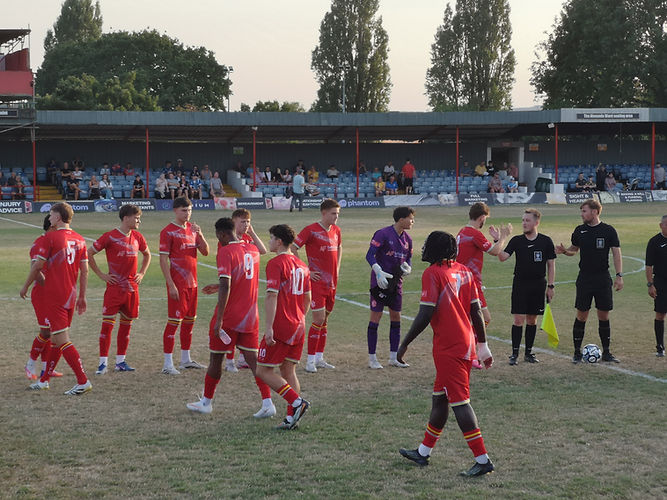
If you have ever wondered what does a football scout look for in a player?, the answer is much more complicated than simply watching to see who scores the most goals or looks good on the ball.
Football scouts are looking at players from a much broader perspective. They assess technical ability, tactical understanding, physical attributes, mentality, decision-making, movement and how a player contributes to the team.
A player might catch a scout's attention because of their pace, passing ability or finishing, but it is often what they do without the ball, how they make decisions and how they respond to different situations that can make a lasting impression.
At The Head Scout, we watch football across different levels and understand that talented players can be found well beyond the professional academies and major stadiums.
So what exactly are scouts looking for?
1. Technical Ability
Technical ability is one of the first things a scout will assess.
Depending on the player's position, this could include:
-
First touch
-
Passing
-
Ball control
-
Dribbling
-
Crossing
-
Shooting
-
Finishing
-
Heading
-
Tackling
-
Ball striking
-
Use of both feet
However, scouts are not simply looking for players who can perform impressive skills.
They want to know whether a player can execute the right technique at the right time.
For example, a midfielder might not make spectacular passes every few minutes, but if they consistently receive the ball under pressure, take a good first touch and play forward quickly, that can be far more valuable to a scout.
Similarly, a winger who beats a defender once with an impressive piece of skill may be less interesting than a winger who repeatedly makes intelligent decisions about when to dribble, pass, cross or run into space.
2. Decision-Making
One of the biggest differences between simply watching football and scouting a player is understanding why the player does something.
Scouts want to see how quickly and effectively a player makes decisions.
For example:
-
Do they know when to pass?
-
Do they recognise when to carry the ball?
-
Do they know when to take a risk?
-
Can they identify space?
-
Do they recognise danger?
-
Do they make good decisions under pressure?
-
Can they change their decision when the situation changes?
A player can have excellent technical ability but still struggle if their decision-making is poor.
Good players often appear to have more time on the ball because they have already scanned the situation and anticipated what is likely to happen next.
England Football's coaching framework highlights capabilities such as scanning, timing, movement, positioning, deception and technique when assessing how players perform actions on the pitch.
3. Tactical Understanding
Scouts are also interested in how well a player understands the game.
This becomes particularly important as players progress through different levels of football.
A scout might ask:
Does this player understand their role within the team?
For example, a central midfielder might need to know when to:
-
Drop between defenders
-
Offer a passing option
-
Turn and play forward
-
Protect the defence
-
Press an opponent
-
Cover a teammate
-
Make a forward run
-
Slow the game down
-
Change the direction of play
A player who understands these situations can be extremely valuable even if they are not the most physically gifted player on the pitch.
Scouting is therefore about more than watching what happens when a player has possession.
4. What Does the Player Do Without the Ball?
This is one of the most important areas that young players sometimes overlook.
When you are trying to impress a scout, it can be tempting to concentrate on what you do when you have the ball.
But scouts are watching you when you don't have it too.
They may look at:
-
Your movement
-
Positioning
-
Pressing
-
Defensive work
-
Runs into space
-
Tracking opponents
-
Creating space for teammates
-
Recovery runs
-
Awareness of what is happening around you
A forward who constantly moves intelligently and creates opportunities for teammates may be more valuable than a forward who simply waits for chances to arrive.
Likewise, a midfielder who works hard to regain possession and maintains good positioning can attract attention even without producing spectacular statistics.
5. Physical Attributes
Physical ability obviously matters in football, although the importance of individual attributes varies considerably by position, age and level.
Scouts may consider:
-
Acceleration
-
Pace
-
Agility
-
Strength
-
Balance
-
Stamina
-
Power
-
Coordination
-
Mobility
-
Jumping ability
But physical ability needs context.
A fast player is not automatically a good footballer.
A strong player is not automatically a good defender.
A player with excellent stamina is not necessarily an effective midfielder.
Scouts are interested in how physical characteristics translate into football performance.
For example, does a player's acceleration allow them to create separation from defenders?
Does a centre-back's strength help them defend effectively?
Does a midfielder's stamina allow them to maintain their performance throughout the match?
6. Mentality and Character
This is an area that can be difficult to judge from a single match, which is why scouts may want to see players more than once.
Mentality can include:
-
Concentration
-
Confidence
-
Determination
-
Resilience
-
Work ethic
-
Discipline
-
Composure
-
Coachability
-
Reaction to mistakes
-
Reaction to setbacks
What happens after a player makes a mistake can tell a scout a great deal.
Do they hide?
Do they become frustrated?
Do they blame somebody else?
Or do they immediately try to correct the mistake and get involved again?
Scouts are often interested in how players respond when things aren't going their way.
7. Personality and Teamwork
Football is a team sport, so scouts are rarely looking only at individual ability.
They may also consider how a player interacts with teammates.
Does the player communicate?
Do they encourage others?
Do they listen?
Do they accept instructions?
Do they work for the team?
Do they show leadership?
A player who contributes positively to the team can have significant value.
This is particularly important when clubs are assessing whether a player will fit into an existing dressing room and playing environment.
8. How Does the Player Respond to Pressure?
Scouts may deliberately pay attention to important moments.
How does a player respond when:
-
The team is losing?
-
They concede a goal?
-
They are being heavily pressed?
-
They miss a chance?
-
They make an error?
-
The opposition becomes physical?
-
The game becomes chaotic?
-
They are asked to play in an unfamiliar position?
These situations can reveal characteristics that aren't always visible when a team is comfortably winning.
A player's performance when everything is going well is useful.
Their performance when things go wrong can be even more revealing.
9. Position-Specific Qualities
There isn't one universal checklist for every footballer.
A scout assessing a goalkeeper will look for different qualities from a scout assessing a striker.
Goalkeepers
Scouts may assess:
-
Shot stopping
-
Handling
-
Positioning
-
Distribution
-
Cross management
-
Communication
-
Decision-making
-
Sweeping outside the penalty area
Defenders
Scouts may look at:
-
Positioning
-
Tackling
-
Interceptions
-
Heading
-
Recovery pace
-
Strength
-
One-on-one defending
-
Passing ability
-
Concentration
Midfielders
Scouts may consider:
-
Passing
-
Receiving under pressure
-
Scanning
-
Positioning
-
Game awareness
-
Ball retention
-
Creativity
-
Defensive contribution
-
Decision-making
Wingers and Wide Players
Scouts may look for:
-
Pace
-
Acceleration
-
Dribbling
-
Crossing
-
1v1 ability
-
Movement
-
Creativity
-
Decision-making
-
Defensive contribution
Strikers
Scouts may assess:
-
Finishing
-
Movement
-
Positioning
-
First touch
-
Link-up play
-
Runs behind the defence
-
Heading
-
Pressing
-
Ability to create chances
These are only examples. Every club will have its own recruitment requirements and player profile.
10. Does the Player Fit the Club?
This is an extremely important point.
A scout isn't necessarily asking:
"Is this player good?"
They may actually be asking:
"Is this player right for our club?"
A technically excellent attacking midfielder might not be suitable for a club that needs a defensive midfielder.
A striker who scores regularly might not fit a team that requires its centre-forward to hold the ball up and link play.
A talented full-back might not suit a system that requires its full-backs to play extremely high up the pitch.
Scouting is therefore closely connected to recruitment strategy.
The FA's talent identification guidance similarly emphasises understanding player potential in the context of talent identification and a club's recruitment environment.
11. Potential, Not Just Current Ability
Especially when scouting younger players, scouts may be interested in potential as well as current performance.
A player might not be the finished article.
Instead, the scout may see:
-
Excellent athletic potential
-
Outstanding technical foundations
-
Intelligent movement
-
Strong mentality
-
Ability to learn quickly
-
A particular physical or technical attribute that could be developed
Young players can develop at very different rates, so scouts need to consider where a player could eventually go rather than simply judging where they are today.
12. Consistency Matters
One impressive performance can attract attention.
But scouts will often want to know whether a player can reproduce that performance.
Can they perform well:
-
Against strong opposition?
-
Against weaker opposition?
-
Home and away?
-
Under pressure?
-
When their team is losing?
-
Across several weeks or months?
Consistency can be just as important as having spectacular moments.
A player who produces one outstanding match followed by several poor performances may present a very different recruitment proposition from a player who consistently performs at a high level.
13. The Level of Football Matters
Scouts can find players at many different levels.
Professional academies and senior professional football naturally attract considerable attention, but talented players can also emerge from:
-
Non-League football
-
Semi-professional football
-
Grassroots football
-
University football
-
Women's football
-
Amateur football
-
Lower divisions
-
Different countries and leagues
This is one reason why watching live football can be so valuable.
A player who is performing particularly well at their current level may deserve an opportunity to test themselves at a higher level.
14. Scouts Look at the Whole Player
Ultimately, good scouting is about building a complete picture.
A scout may combine observations covering:
Technical
Can the player execute the required football actions?
Tactical
Does the player understand the game and their role?
Physical
Do their physical attributes support their position and playing style?
Psychological
How do they think, react and behave?
Social
How do they interact with teammates and the wider environment?
The FA's 4 Corner Model similarly promotes a holistic approach, considering technical/tactical, physical, psychological and social areas rather than viewing a player through one characteristic alone.
What If You Want to Get Scouted?
If you are a player hoping to attract the attention of a football scout, don't concentrate exclusively on scoring goals or performing spectacular skills.
Think about the complete performance.
Work on your technical ability, but also improve your decision-making.
Work on your fitness, but also improve your tactical understanding.
Show your ability when you have the ball, but make sure scouts can see what you do when you don't have it.
And perhaps most importantly, play football regularly at the highest level you can realistically compete at.
The more football you play, the more opportunities you have to demonstrate your ability.
Make Yourself Easier for Clubs and Scouts to Find
One of the biggest challenges for players isn't necessarily ability.
It is visibility.
There are thousands of footballers playing across the UK and beyond, and clubs cannot watch everybody.
That is why having a clear football profile can be useful.
A good player profile might include:
-
Name
-
Age
-
Position
-
Current club
-
Previous clubs
-
Location
-
Playing level
-
Preferred foot
-
Height
-
Relevant experience
-
Video footage
-
Contact information
-
Availability
-
What type of opportunity you are looking for
At The Head Scout, we are developing tools and opportunities designed to help connect players, clubs and people working within football.
If you are a player looking for your next opportunity, you can also submit your details through our Players Looking for Clubs section.
Are You a Club Looking for Players?
The same principle works in reverse.
Clubs need to make it easier to identify players who may be suitable for their requirements.
Whether you are a professional club, semi-professional side, grassroots team or another football organisation, recruitment can benefit from combining live scouting, player recommendations, databases, video analysis and direct contact.
If your club is looking for players, explore our Clubs Looking for Players section or get in touch with The Head Scout to discuss scouting and player recruitment opportunities.
What Makes a Player Stand Out to a Scout?
There is no magic formula.
Different scouts and clubs will have different requirements.
But a player who combines technical ability, tactical understanding, physical qualities, intelligence, mentality, work ethic and consistency is likely to provide a much more compelling scouting profile than someone who relies on one outstanding attribute.
And remember that scouts are not necessarily looking for the player who does the most spectacular thing.
Sometimes the most impressive player is the one who consistently makes the right decision.
That can be much harder to spot from the stands — and that is exactly why good scouting matters.
Want to Get Noticed?
If you are a footballer looking for a club or an opportunity, don't simply wait for somebody to discover you.
Build your profile, make your experience and abilities clear, continue developing your game and put yourself where scouts and clubs can find you.
The Head Scout is building a football network designed to connect players, clubs and scouting opportunities.
If you are looking for your next football opportunity, visit our Players Looking for Clubs section and submit your details.
If you are a club looking for players, visit our Clubs Looking for Players section to find out how you can advertise your requirements.
And if you need a football scout to assess a player, opposition or recruitment target, contact The Head Scout to discuss your requirements.